


It's Friday afternoon. You've been running camp for two weeks. Somewhere in your desk is an envelope with $340 in cash from families who paid for lunch, a sticky note that says "the Martins e-transferred but I can’t find it," and a list of four families you’re pretty sure haven’t paid yet but you can’t be certain because you’ve been too busy to reconcile the spreadsheet since Tuesday.
This is camp lunch billing. And the maddening thing about it is that none of this work has anything to do with running a good camp. It’s administrative overhead that you absorbed because it felt easier than setting up something else.
It isn’t easier.
What Cash Collection Actually Costs You
When a camp collects lunch payments directly, every dollar that comes in creates a chain of work. Someone has to receive it. Someone has to track it. Someone has to reconcile it against who’s ordered what. Someone has to handle refunds when a kid is sick for three days mid-week. Someone has to follow up with the families who haven’t paid.
In a school with a dedicated administrative staff, this is manageable. At a day camp, where the people running operations are often the same people managing activities, planning schedules, handling parent calls, and putting out whatever today’s actual fire is — it’s a real drain.
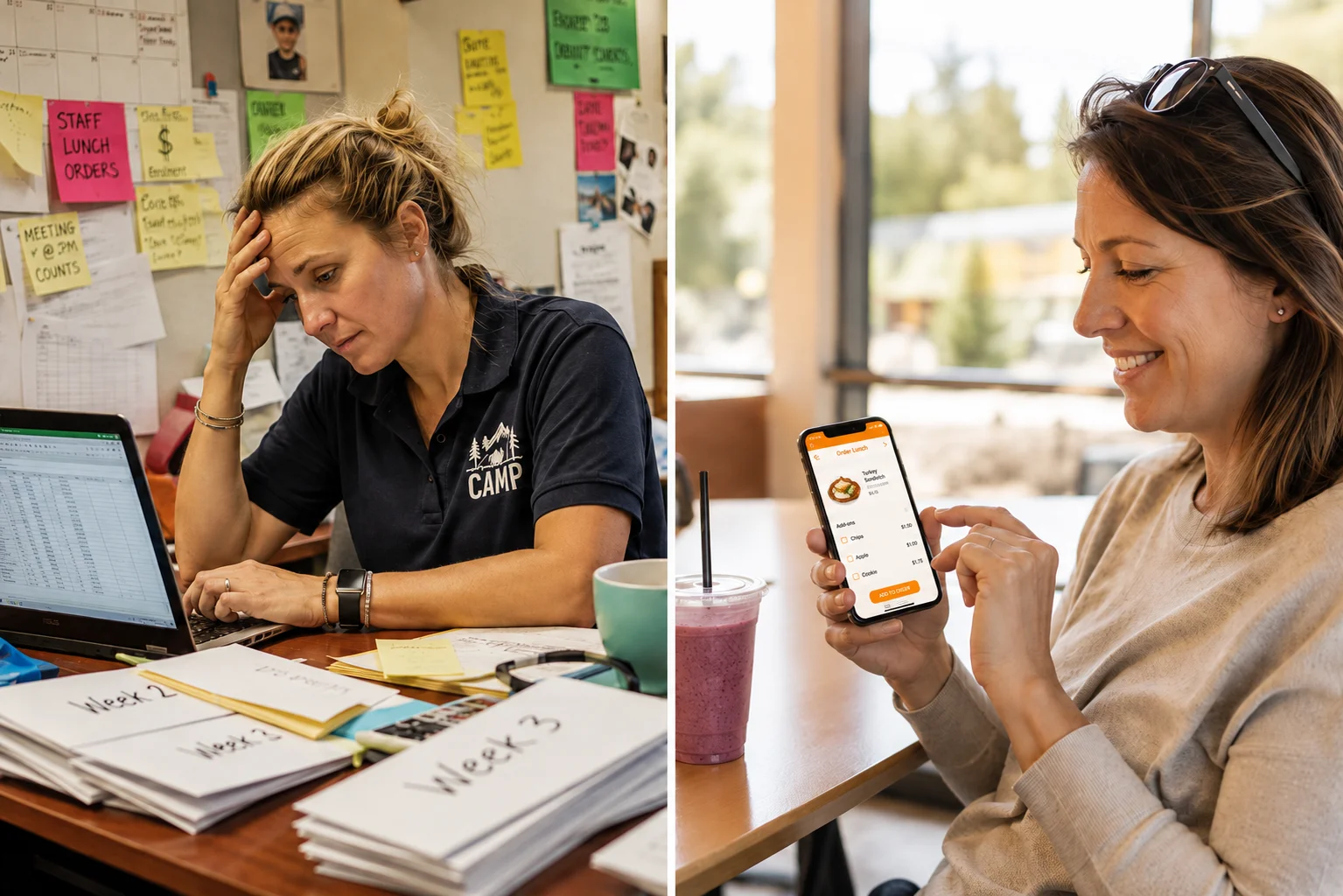
The other problem with cash and e-transfers is that they create disputes. Parents who swear they paid. E-transfers that were sent to the wrong address. Families who paid for three weeks but only attended two, and now want a partial refund, and the math on what they’re owed requires going back through records from week one.
This isn’t a hypothetical. If you’ve run a camp lunch program for more than one summer, you’ve lived a version of this.
The Zero-Contact Payment Model
The cleanest version of camp lunch billing is one where the camp never touches money at all. Parents pay the meal provider directly. The camp’s role is purely logistical — confirming who’s attending, making sure meals are distributed, handling the experience on the ground. For a full breakdown of that operational side, see How to Actually Run Lunch at a Day Camp. The financial relationship is between the family and the vendor.
This is how LunchUp works. Parents order and pay online, directly through the platform. The camp never handles cash, never processes an e-transfer, never chases a family for payment, and never issues a refund. If a child is sick and a parent needs to cancel an order, they do it themselves before the cutoff time and receive a credit automatically. No one at camp needs to be involved.
For families, this is also a better experience. They can order for a week at a time, see exactly what their child is eating, and manage changes on their own schedule without calling the camp office. The transparency is reassuring, especially for first-time camp families who are still figuring out how everything works.
Reconciliation Without the Spreadsheet
One of the quieter benefits of an online ordering system is that the records are always current and always accurate. You don’t need to reconcile a spreadsheet at the end of the week because the system has already done it. Every order is timestamped. Every payment is recorded. Every cancellation has a trail.
For camp directors who also have to report to a board or ownership group, this kind of clean documentation is useful beyond just lunch. It’s a record of participation, a data point for planning next season, a way to see which weeks had lower attendance and why. Information you were already generating, now actually accessible.
What to Tell Families When You Make the Switch
If you’re moving from a cash-based lunch system to an online one, some families will push back initially. Change is friction, and parents who are already juggling camp registration, medical forms, and supply lists don’t want to set up a new account for something that used to be handled by dropping an envelope at the front desk.
The framing that works: this is less work for them, not more. One-time account setup, order whenever it’s convenient, modify or cancel without calling anyone. After the first week, most families who were skeptical become the ones recommending it to new camp families at pickup.
The goal for a camp lunch program should be that it runs cleanly in the background — and lunch is also one of the strongest enrollment signals you can give working-parent families. That’s a reasonable standard. — that kids eat well, families feel taken care of, and nobody on your team is spending Friday afternoon counting envelopes. That’s a reasonable standard. It’s also achievable.
Ready to Transform Your School's Lunch Program?
Join thousands of schools already using LunchUp to provide healthy, convenient meals for their students.