


Running lunch at a day camp is one of those things that sounds straightforward until you're actually doing it. Then you're three days in and you've got four kids who won't eat what you ordered, two counselors who are supposed to be doing activities but are sorting food bags instead, and a parent calling to ask why their child came home hungry on Tuesday.
Lunch is a small word for a big operational challenge. Here's how to actually handle it.
The Problems That Catch You Off Guard
Before getting into solutions, it helps to name the specific things that go wrong — because "lunch is complicated" is not a useful planning input.
Variable headcount. Day camp enrollment isn't static. Some families book week by week. Kids are sick, on vacation, attending part-time. If you're ordering catering in bulk and your headcount assumptions are off by 15%, you either run short or waste food. Neither is good.
Allergy and dietary restrictions. You will have campers with allergies. (This is the most legally and reputationally risky area of camp lunch — and the most under-managed.) You will have vegetarian families, halal families, gluten-free families. In a school, teachers know their class. In a camp, counselors are meeting 25 kids for the first time on Monday morning and managing everyone through a full day of activities. They don't have the bandwidth to track who can't eat what without a system.
Staff time. Every minute a counselor spends managing lunch is a minute they're not doing what you hired them to do. Sorting bags by group, tracking down a missed order, answering "what's for lunch today" is work — and it accumulates.
Unpredictable group sizes. Drop-ins, partial-week bookings, kids moving between groups — the number of campers in each group on a given day can look different from what was registered on Monday. If meal distribution is organized by group, and group sizes shift, you need a system flexible enough to handle it.
Build Around Per-Camper Ordering, Not Bulk Catering
The instinct for most camps setting up a meal program is to go bulk: order enough food for estimated attendance, set it out buffet-style or pre-box it by group. This works until it doesn't — which is the day three kids are unexpectedly absent, four others showed up who weren't expected, and you have the wrong number of vegetarian options.
Per-camper ordering solves the headcount problem cleanly. Each meal is tied to a specific camper. Families order for the days their child is actually attending. If attendance changes, the order changes. There's no guessing, no waste, no scrambling.
It also solves the dietary restriction problem. When allergy and dietary information is stored per-camper in the ordering system, it travels automatically with every order that camper places. The counselor distributing bags doesn't need to remember who has what restriction — the label on the bag tells them.
Label-Based Distribution: The Detail That Makes Lunch Run Smoothly
If you've ever watched a counselor try to match 25 generic lunch boxes to 25 kids while simultaneously managing the noise and energy of a full camp gymnasium, you understand why this matters. It's slow, it's error-prone, and it takes the counselor's full attention for a window of time that could otherwise be used for the actual job.
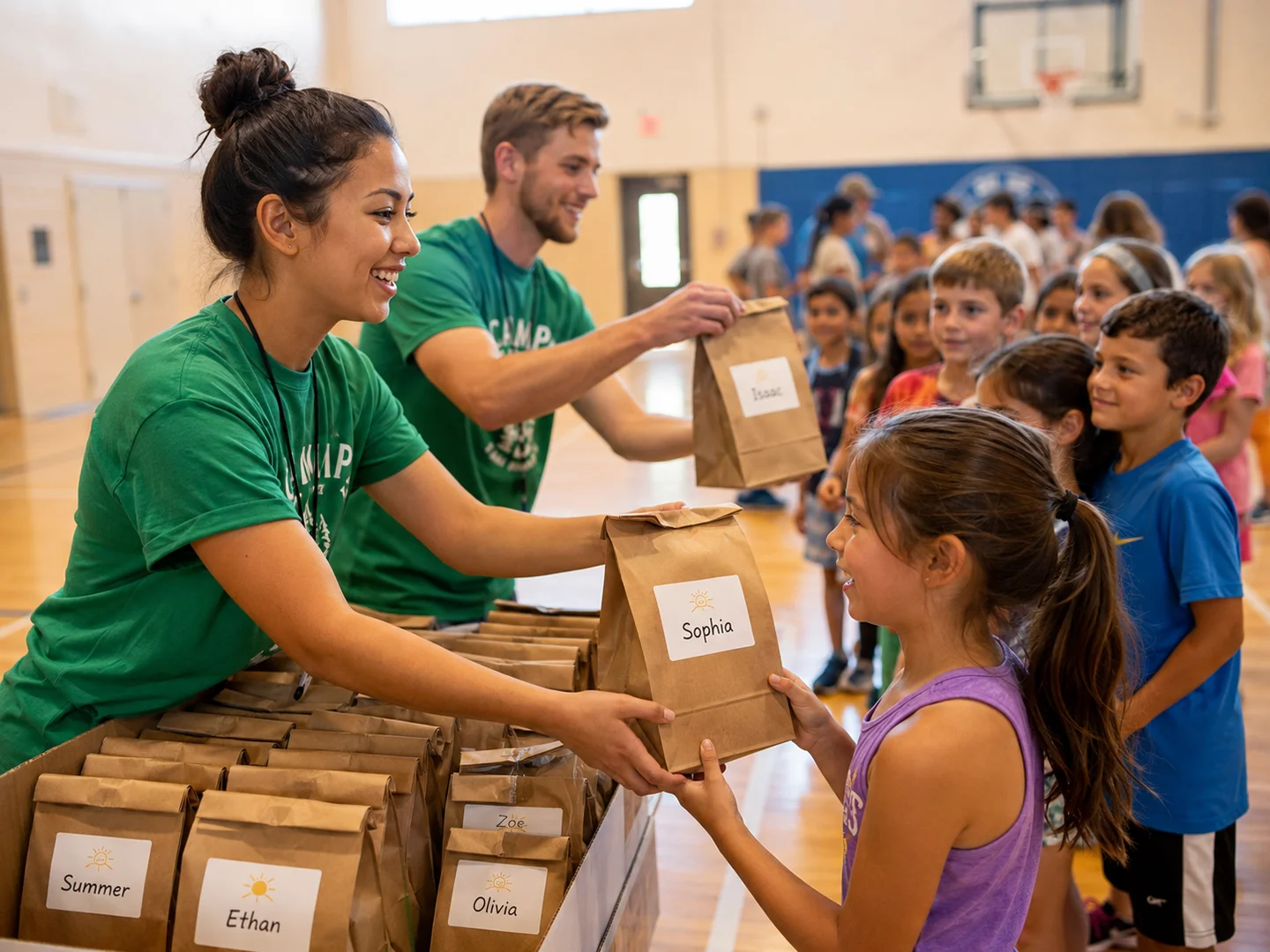
When every meal is labeled with the camper's name and group, distribution is a matching exercise, not a puzzle. You hand each child their bag. Done. A two-person job instead of a four-person job. Five minutes instead of twenty.
This sounds like a small operational detail. In practice, it's one of the biggest quality-of-life improvements for the lunch portion of a camp day — for staff and for kids, who get their food faster and with less confusion.
The Licensed Vendor Question
Many day camps operate in rented facilities — school gyms, community centres, church halls — that don't have licensed commercial kitchens. This creates a compliance question that's easy to overlook: if you're serving food to children in a regulated program, it should come from a licensed food preparation facility.
Partnering with licensed local restaurants and vendors through a platform like LunchUp resolves this cleanly. The food is prepared in a facility that's subject to health inspection. The compliance piece is handled by the vendor, not the camp. What reaches your campers is a meal that meets food safety standards from preparation through delivery — not something assembled in a home kitchen or a facility that wasn't designed for it.
What “Lunch Handles Itself” Actually Looks Like
The goal for any well-run camp lunch program is that it operates in the background of your day. Not something your staff manages — something that just happens, reliably, while your team is doing what they're there to do.
With LunchUp, here's what the lunch flow looks like on a typical camp day: families order online for their camper in advance. Meals are prepared fresh by local restaurant partners and delivered in the late morning window. Bags arrive sorted by group, labeled by camper name. Two staff members distribute in under ten minutes. Everyone eats. No cash was handled, no allergy check was left to memory, no counselor spent their activity time managing food logistics.
That's the standard worth aiming for. It's also achievable without a commercial kitchen, a dedicated food coordinator, or a summer's worth of administrative overhead. You just need the right system behind it.
Ready to Transform Your School's Lunch Program?
Join thousands of schools already using LunchUp to provide healthy, convenient meals for their students.